During their second stay in Roussillon from November 1924 to May 1925 Charles Rennie Mackintosh and his wife Margaret stayed in Ille-sur-Têt. They stayed in a small, comfortable, but simple and inexpensive hotel: “The Hotel du Midi” on the RN27.
The building still exists today and has become a café and pizzeria: the building has remained unchanged with its rockwork balconies (a composition of cement mortar that imitates nature like the trunks of trees. These dreamlike, baroque creations became popular in the 19th century).
Four watercolours produced by Charles Rennie Mackintosh bear witness to this visit to the region, including one entitled “The Southern Farm”.
The watercolour depicts a farmhouse, one of Charles Rennie Mackintosh’s favourite subjects.
Charles Rennie Mackintosh positioned himself at the edge of the railway line in front of the eastern side of the farmhouse to produce his work.
The farmhouse occupies the upper half of the canvas. It consists of a dwelling on the right and on the front, on the left, a lower outbuilding parallel to the barn. The walls are white ochre, and the roofs are covered with brown round tiles.
In front of the farmhouse is an area of land: a brown ochre courtyard that occupies the whole front of the painting. A lighter circle can be seen on the ground with a stake in its centre (a threshing floor?).
At the back of the farmhouse, a row of green trees can be seen, probably olive trees.
Pictorial analysis
Mackintosh chooses to draw attention to modest details – the tethering post and the ground worked by the absent farm animal, and the silhouette of the rooster in the open doorway.
Professor Pamela Robertson – University of Glasgow – S.Plas with kind permission of the author
The composition of this watercolour is strange. Mackintosh has curiously left a huge foreground empty and has concentrated on describing the somewhat unusual architecture of this farmhouse by contrasting shadows (painted in cold colours) with lighted areas. The upper part is devoted to a large flat area showing a row of olive trees, the sky being almost non-existent.
Note the presence of an unusual Mackintosh detail: the rooster standing out in light against the dark doorway.
Location
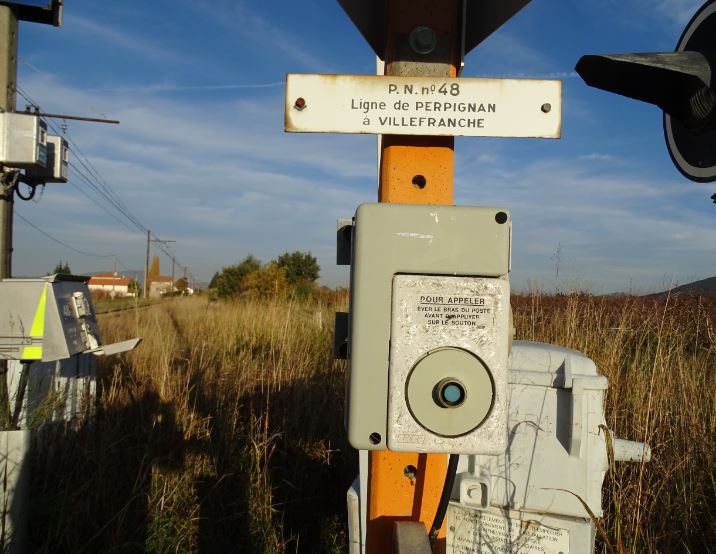
The mas is situated in a bend between the old road that leads from Ille sur Têt to Bouleternère and the railway line that goes from Perpignan to Villefranche de Conflent, just before crossing the level crossing.
It still exists but has been completely renovated with the addition of many picture windows. The front outbuilding has been destroyed. The property is surrounded by a hedge, and a garden has been created in place of the land.
The chair on which this work is based is not located here, but in Ille-sur-têt, near the Hôtel du Midi, at the intersection of the Rue des Pommiers and the Route Nationale.
Itinerary for Mas Saunier
Itinerary for the chair